Budget and project cost: why your budget matters
One of the first questions we often ask when someone comes to us with a potential project is:
“What is your budget for the building work?”
It is a simple question, but it often produces one of two responses:
“We don’t really know what it will cost.”
or, occasionally:
“We don’t really want to tell you our budget.”
Both responses are completely understandable. Building or renovating a property is a significant financial commitment, and if you don’t have experience of construction it can be very difficult to know what a realistic budget might be.
So why do we ask?
Your budget isn’t the same as the cost of the project
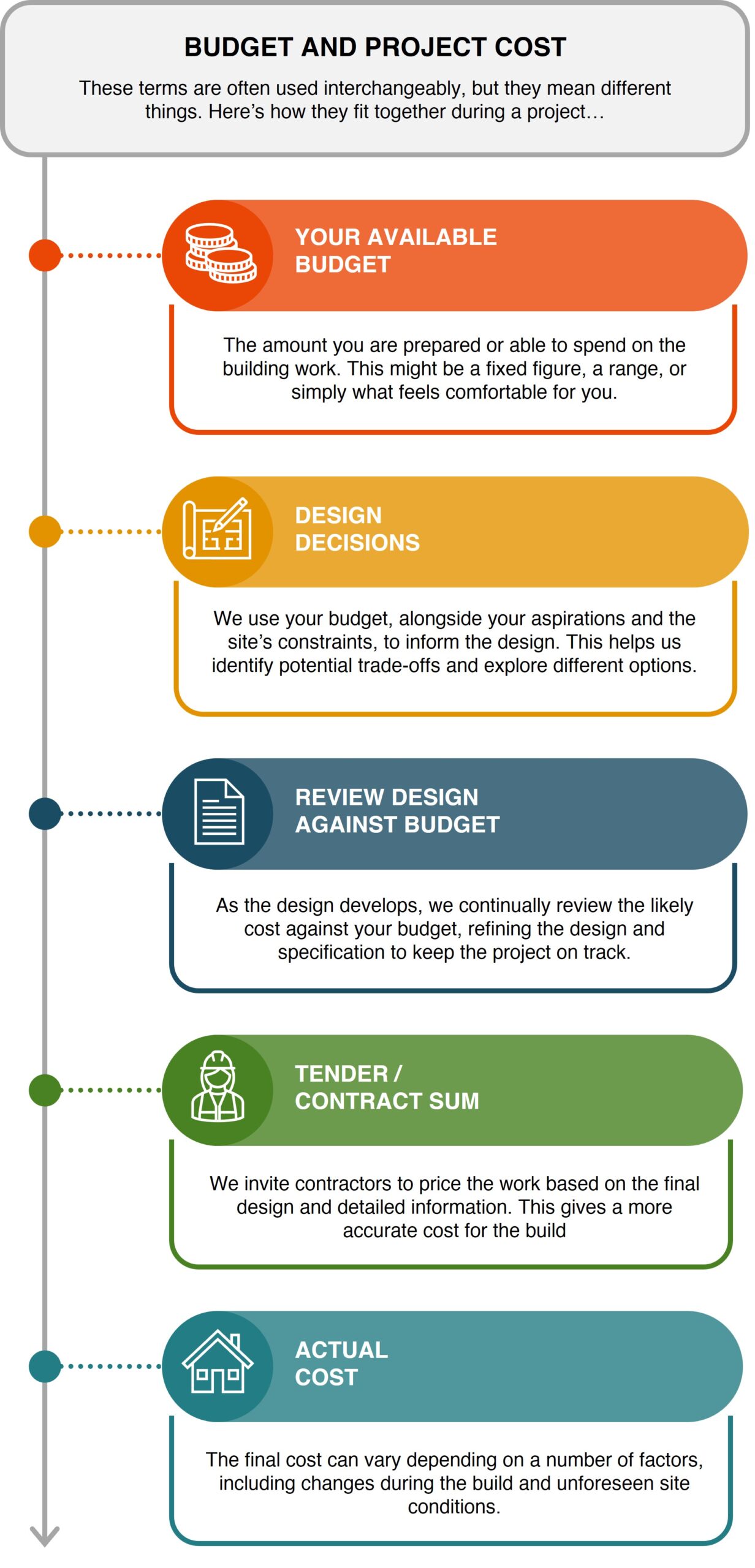
When we ask about your budget, we aren’t necessarily asking you to predict what the project will cost. We are trying to understand how much you are prepared, or able, to spend on the building work.
The eventual project cost is something we work towards establishing through the design process, informed by the scope of the work, the quality and specification of the building, and ultimately by detailed cost information and contractor quotations.
Your budget is therefore an important starting point.
For example, you might tell us that you have around £250,000 available for the building work. You may have no idea whether the project you have in mind will cost £200,000, £250,000 or £350,000.
That’s OK.
In fact, that’s one of the reasons for involving an architect.

Why we need to know your budget
A building project has to balance three things:
What you want to achieve, what it is likely to cost, and what you are prepared to spend.
If we understand your budget at the outset, we can start thinking about all three together.
This doesn’t mean that we will simply design a project that spends every last penny of it. Quite the opposite. Knowing the budget helps us understand the parameters within which the design needs to work.
It might mean that we suggest doing certain things differently. We may identify where spending more would make a significant difference, and where it would have relatively little benefit. We can also identify elements of the project that might need to be reduced or reconsidered if the initial scope appears unrealistic for the available budget.
The earlier we understand this, the easier it is to make sensible decisions.
“I don’t know what it should cost”
This is probably the most common response we hear, and it is entirely reasonable.
Most people don’t build houses or undertake major extensions regularly enough to have a good understanding of current construction costs.
If you tell us what you are hoping to achieve, we can use our experience to give you an initial indication of whether your expectations and your available budget appear broadly realistic.
That isn’t the same as providing a firm quotation for the finished building.
Construction costs vary considerably depending on the size and complexity of a project, its location, the existing building and site, the specification, structural requirements, ground conditions and many other factors. Costs can also change over the course of a project.
But an early conversation about budget can identify a potential mismatch before significant time and money has been spent developing a design.
“If I tell my architect my budget, won’t they just spend it?”
We understand why some clients are reluctant to give us a figure for exactly this reason.
Our view is that knowing your budget allows us to design more intelligently, not simply spend more.
There will usually be parts of a project where additional expenditure could improve the design, and others where it makes little sense to spend more.
Our role is to help you understand those choices.
A good architect should be able to explain why something costs more, what benefit that additional expenditure provides, and whether there might be a more sensible way of achieving the same result.
Sometimes the best design decision is not to spend more.
Budget is a design parameter
We don’t see budget as something that is dealt with after the design has been completed.
It is one of the parameters that should inform the design from the beginning, alongside the site, the existing building, planning requirements, your aspirations and the way you want the finished building to work.
This is particularly important on larger or more complex projects. A beautiful design that cannot be delivered within a client’s means is not a successful project.
Good architecture has to work in the real world.
What should your budget include?
When we ask about your budget, it is helpful to be clear about what the figure represents.
For example, you may be thinking about:
- the amount available for the building works;
- the overall amount you are prepared to invest in the project;
- money you have available now versus money you may borrow;
- or simply an amount that you feel would be comfortable to spend.
These aren’t necessarily the same figure.
The cost of the building work is also only one part of the overall cost of undertaking a project. Depending on the nature of the work, there may also be professional fees, surveys, structural engineering, planning or other statutory fees, specialist consultants, VAT and other project costs.
We can help you understand these different costs as the project develops.
So, what should you tell your architect?
You don’t need to have a precise figure.
If you genuinely don’t know, tell us that.
If you have a rough idea, tell us that.
And if you have a maximum amount that you would be uncomfortable exceeding, that is useful information too.
For example:
“We think we’d be comfortable spending around £300,000 on the building work, but we’d ideally like to spend less.”
is much more useful to us than:
“We don’t know what it will cost.”
It gives us a starting point from which to explore what might be achievable.
Ultimately, your budget isn’t a target for us to spend. It is one of the constraints within which we need to find the best possible design.
The earlier we understand that constraint, the better we can help you make informed decisions about your project.
More resources
Budget and project cost: why your budget matters
One of the first questions we often ask when someone comes to us with a potential project is: “What is your budget for the building work?”...
Read moreAwards, News and Publications
Carve Architecture are an award wining Architects Practice. We also occassionally have magazine and newspaper articles written about us and our projects. This page collates these...
Read moreLiving Roofs: A Guide to Green Roofs and Their Benefits
Green roofs are an increasingly popular roofing finish, as they can transform a plain roof into a thriving garden and offer numerous benefits for both the...
Read moreHeritage Buildings- Things to Consider
We are lucky to be based in two cities with rich architectural heritages, in Newcastle and York. As such, we regularly work with historic buildings, and...
Read moreDo you need Planning Permission?
There are many ways to renovate or extend your home without the need for Planning Permission. This is called Permitted Development...
Read moreDo I Need An Architect?
So you’ve decided you want a new extension, but where to start? The big question we often get asked at an early stage is “Do I need an Architect?"...
Read more